
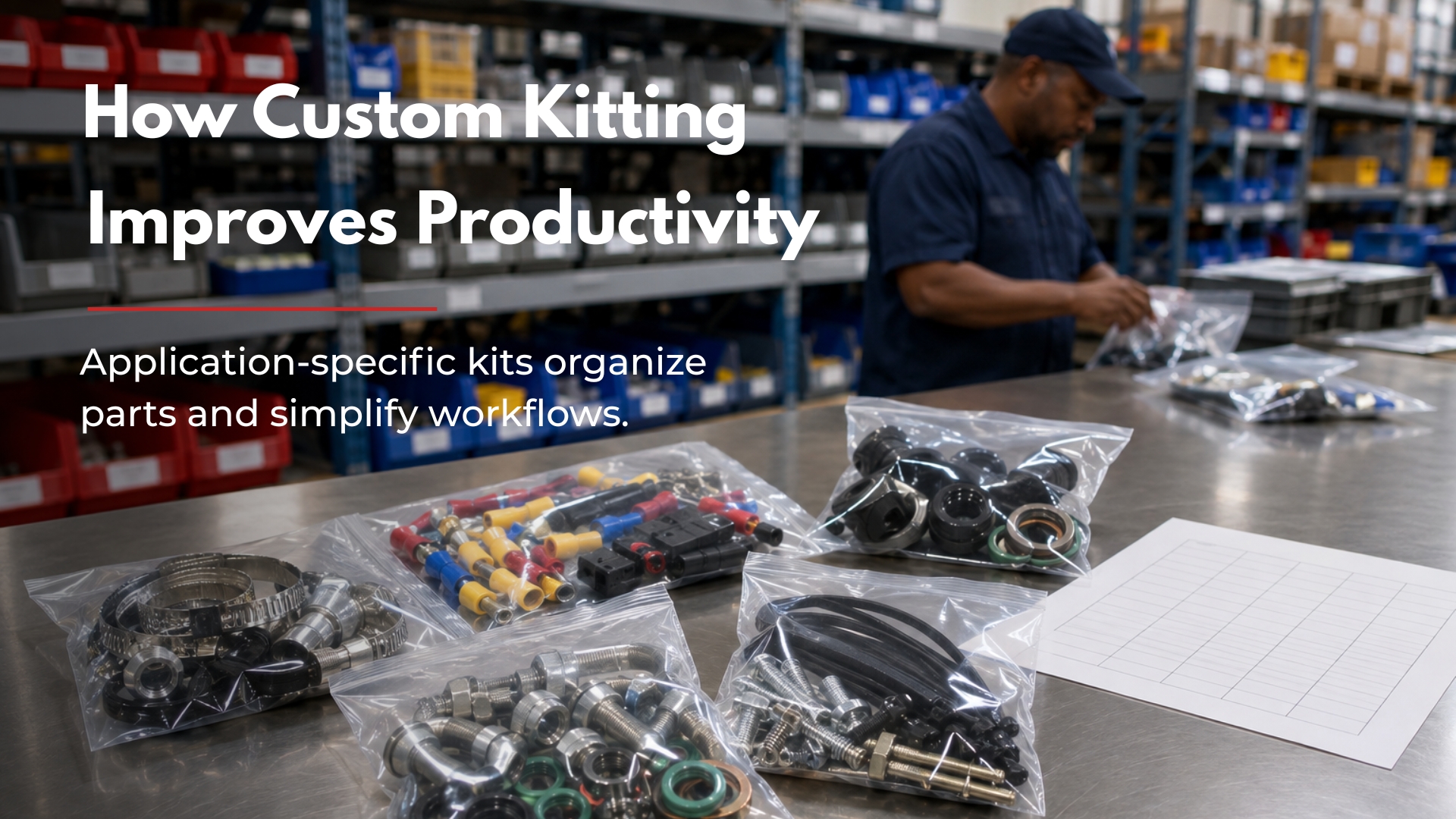
How Custom Kitting Services Improve Productivity and Simplify Operations
Custom kitting services organize the components required for a specific job or assembly into one application-specific package before work begins. For the right process, kitting can reduce walking, searching, and part selection at the point of use, simplify production preparation, and improve product-cost visibility. It does not eliminate preparation work; it moves that work upstream, so its value depends on the application and current material-supply process.
For maintenance, operations, and purchasing managers, that distinction matters. A kit should solve a defined preparation problem, not simply add another step. The best way to evaluate custom kitting is to understand what it does, how a kit is created, and where it may or may not improve the way your team works.
What Are Custom Kitting Services?
Custom kitting is the process of grouping a defined collection of components or subassemblies for a particular product, job, or assembly operation. The National Institute of Standards and Technology describes a kit as a collection of components or subassemblies that supports one or more assembly operations for a product or shop order. Unlike a general assortment, the contents of a custom kit are selected for an intended application and may vary with the product or configuration being assembled. (NIST, Metrics and Test Methods for Industrial Kit Building)
For example, a recurring maintenance task may require a defined set of fasteners, connectors, clamps, and other components. Without a kit, someone may need to locate and gather each item separately before work can begin. With a custom kit, those specified products are prepared together for the application.
This makes custom kitting both a material-supply method and a preparation strategy. The goal is not simply to place products in a package. It is to organize the required products around the work that will be performed.
The Role of the Bill of Materials
A bill of materials, commonly called a BOM, identifies the materials or components and quantities required for a product or assembly. Depending on the application, the required-materials list may also include consumables such as fasteners, adhesives, or lubricants. (NIST, Reference Architecture for Smart Manufacturing: Part 1)
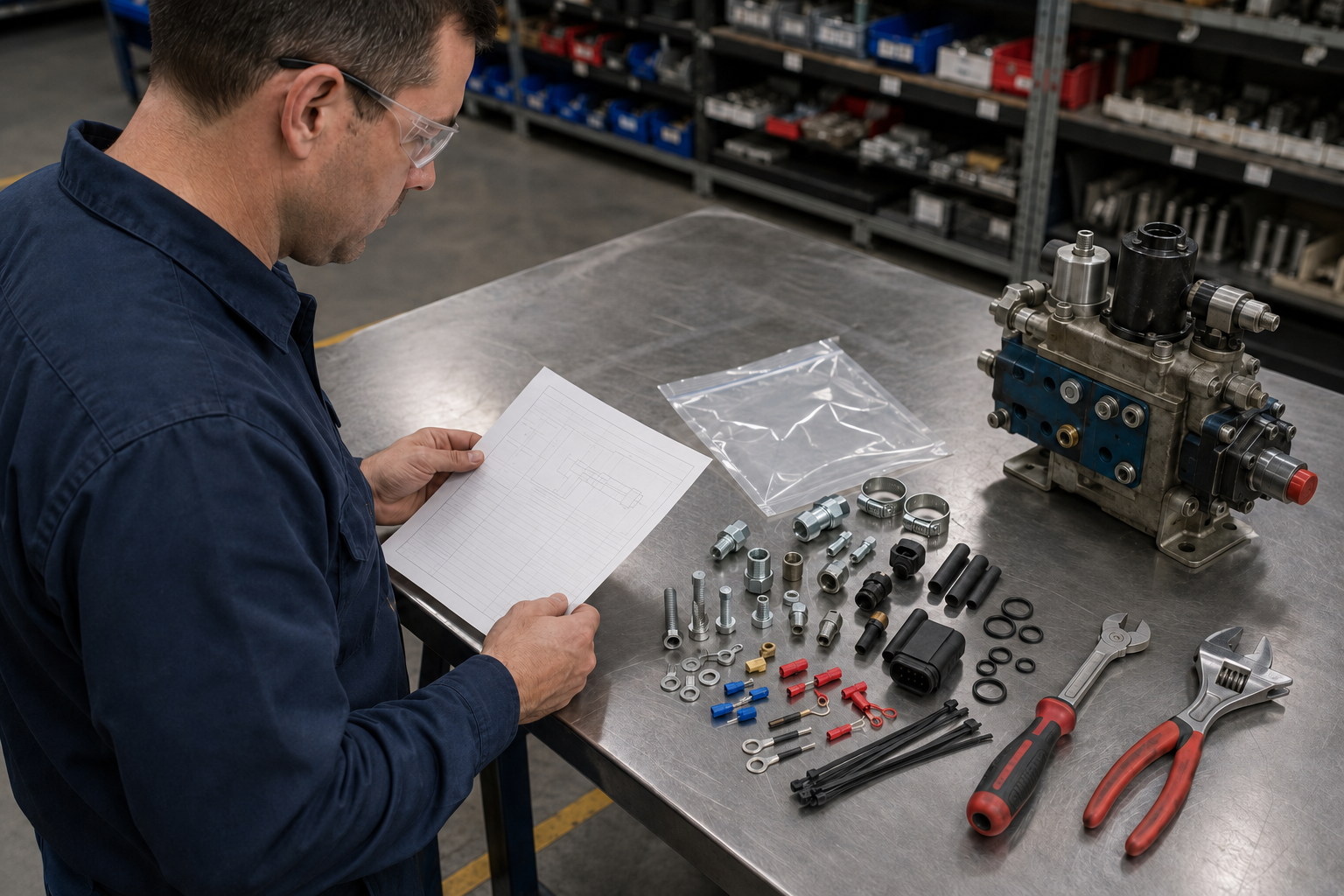
The BOM gives a custom kit its structure by establishing what belongs in the kit and the quantity of each product required for the intended application.
Ram Products builds custom kits according to customer-provided requirements. A Ram Product Application Specialist can help identify needed products and suggest items that may support or improve the proposed kit. The customer ultimately approves the final contents, and Ram does not add products outside the agreed-upon BOM.
Product recommendations can support kit development, but the customer remains responsible for approving the requirements that define the kit.
How Custom Kitting Services Can Improve Productivity
The productivity opportunity comes from changing when and where preparation occurs. Instead of asking a technician or assembler to locate each product when the job starts, the specified components are selected and organized earlier in the process.
That change can simplify work at the point of use, but the complete material-supply system still matters. The preparation work must be performed accurately somewhere.
Reduce Parts Gathering at the Point of Use
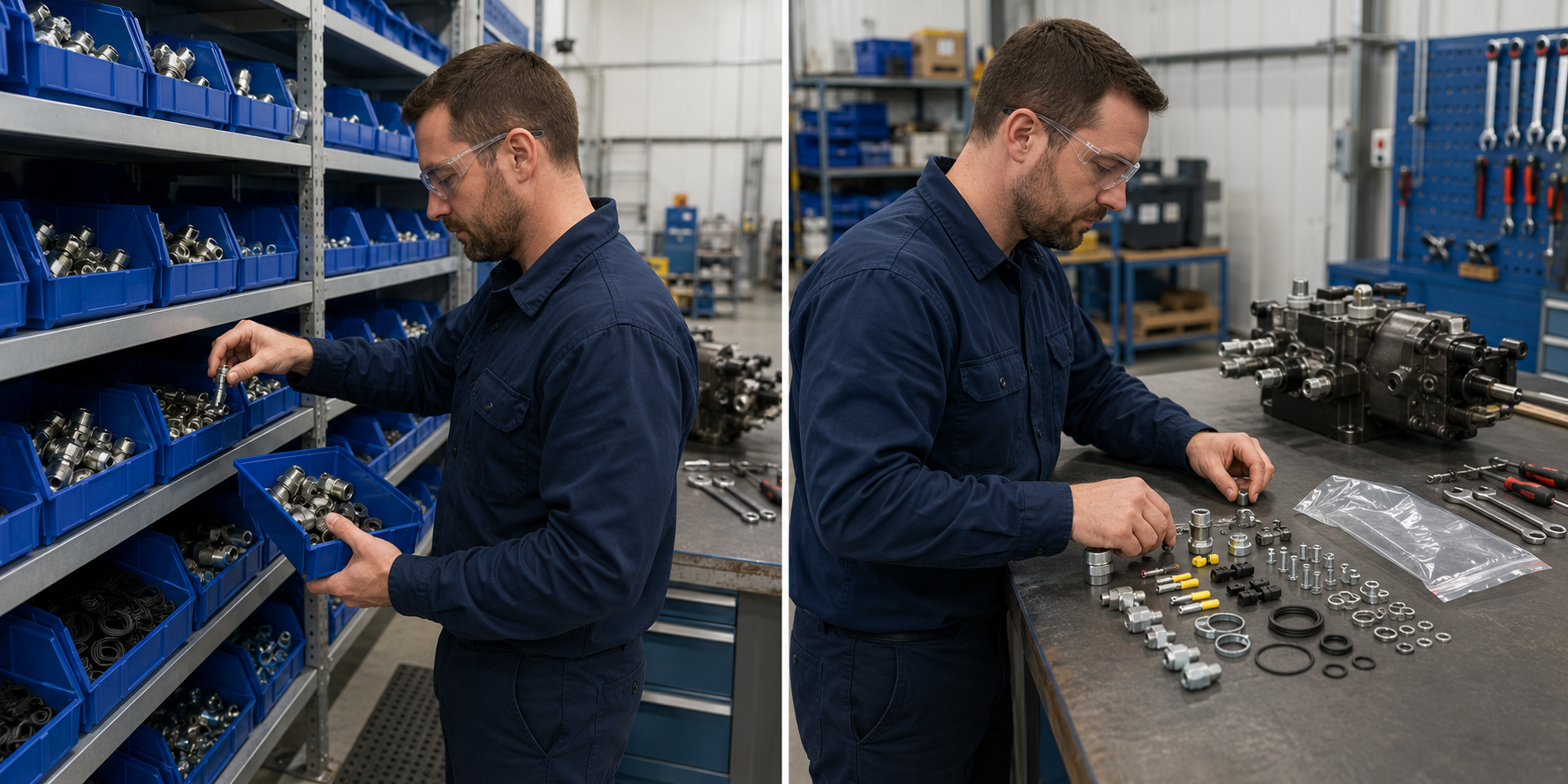
Walking to storage locations, searching bins, and selecting among similar components consume time at the point of use. NIST identifies reduced walking and searching by assembly workers as potential advantages of kitting. (NIST, Metrics and Test Methods for Industrial Kit Building)
In a kitted process, part selection occurs upstream. The person performing the maintenance or assembly task receives the specified products together instead of visiting multiple storage locations. This can keep attention on the application rather than on gathering materials.
One Toyota material-handling example illustrates the tradeoff. Parts selection moved to material handlers, allowing assembly operators to remain in a smaller work area and focus on installation. Toyota estimated that the total productivity change was neutral because the system required more material handlers, and the company said the approach was not applicable to all production areas. (Lean Enterprise Institute, Toyota's New Material-Handling System Shows TPS's Flexibility)
This automotive example does not predict the result for another facility. It shows why managers should evaluate the whole process: kitting may reduce gathering work for the person completing the job while transferring that work to the people and processes preparing the kit.
Simplify Production and Maintenance Preparation
When all specified products for an application are prepared together, the kit can provide a clear starting point for the job. For a recurring task, a technician may no longer need to gather the same defined material list one item at a time. An assembler may be able to begin a defined operation with the specified components already organized.
Custom kitting may be worth evaluating when:
- The same job or assembly is performed repeatedly.
- One application requires multiple components from different storage locations.
- Similar products or product variants must be selected for different configurations.
- Parts gathering regularly interrupts the start of planned work.
These conditions do not guarantee a productivity improvement. They indicate that moving preparation upstream may reduce the number of material-selection decisions made at the point of use. (NIST, Metrics and Test Methods for Industrial Kit Building; Hanson and Medbo, Man-hour Efficiency of Manual Kit Preparation)
Improve Inventory and Product-Cost Visibility
Custom kitting can give purchasing and operations managers a clearer view of the products assigned to an application. Ram positions kitting as a way to increase transparency into product costs and support the management of labor, inventory, and storage cost of goods. (Ram Products, Custom Kitting Services)
Cost visibility is not the same as guaranteed cost reduction. Ram's public service page does not provide measured savings for these outcomes. The practical value is that Maintenance, Operations, and Purchasing can review the products for a defined application using the same agreed-upon BOM.
Support Difficult-to-Find Product Sourcing
A kit is useful only when the required products can be obtained. Ram's sourcing team uses supplier resources to locate certain difficult-to-find or non-stocked products, reducing the need for customers to search for each item independently. Ram states that it has thousands of products in stock and access to thousands more. (Ram Products, Custom Kitting Services)
Combining sourcing support with application-specific kitting may help reduce exposure to parts-related delays when a recurring job depends on products that are not easy to locate. It cannot prevent every shortage or supply-chain disruption, so product requirements and timing should be discussed before the kit is put into use.
What Custom Kitting Does Not Automatically Solve
Custom kitting can simplify preparation, but it is not an automatic productivity improvement for every process. Three limitations should be part of the decision.
First, kitting relocates work rather than making it disappear. Someone still has to pick and prepare the required components. A peer-reviewed study of 15 automotive cases found that the design and operating context of a kit-preparation system can have a decisive but complex effect on labor efficiency. The authors also caution that using only automotive cases may limit how broadly the findings can be generalized. (Hanson and Medbo, Man-hour Efficiency of Manual Kit Preparation)
Second, a kit does not make errors impossible. Research on industrial kit preparation identifies potential errors such as missing components, wrong components, damaged components, incorrect quantities, and incorrectly positioned components. The same research connects kit quality with preparation-process design. (Fager et al., Links Between Kit Quality and Kit Preparation Design)
Third, kitting is one material-supply option, not a universally superior replacement for line stocking, point-of-use storage, or replenishment. One manufacturer profiled by the Lean Enterprise Institute removed a kitting step from a high-volume process and used hourly point-of-use replenishment as part of a different production design. (Lean Enterprise Institute, Sustain Your Lean Business System with a “Golden Triangle”)
These limitations do not mean kitting is ineffective. They mean the decision should be based on the specific operation, current material flow, and problem the kit is expected to solve.
Is Custom Kitting Right for Your Operation?
Operations with repeatable applications and clearly defined preparation problems may be worth evaluating for custom kitting. Use the following questions as a starting point.
Operational signal | Question to ask |
Repeated jobs or assemblies | Does the same task regularly require the same defined group of products? |
Multiple required components | Must employees visit several locations or bins before work can begin? |
Excessive gathering or searching | Is point-of-use preparation consuming attention that could be focused on the job? |
Numerous product variants | Does each configuration require a different but predictable set of components? |
Limited point-of-use space | Would delivering an application-specific quantity be more practical than storing many individual products near the work area? |
Difficult-to-source products | Does the team repeatedly spend time locating required components? |
Need for product-cost visibility | Would defining products at the kit or application level make internal review easier? |
No single “yes” proves that kitting will produce a positive return. These questions identify processes worth evaluating. A sound review should compare the proposed kit with the time, labor, space, inventory, and controls required by the current method.
When Another Supply Method May Be Better
A separate kitting step may add limited value when a process uses only a few products, point-of-use inventory is already simple and reliable, or material requirements change too often to maintain a stable kit definition.
In some high-volume settings, frequent replenishment or line-side supply may be more practical. Conversely, a high-variety process with many component options may provide a stronger reason to evaluate kitting. The right method depends on how materials move through the specific operation. Toyota said its kitting system was not applicable to all production areas, while the Phase 2 case replaced kitting with hourly point-of-use replenishment for its redesigned process. (Toyota example; Phase 2 example)
Before selecting custom kitting, compare it with the current process and realistic alternatives. The goal is not to use kitting everywhere. It is to use the material-supply method that best supports the work.
How Ram Products Builds a Custom Kit
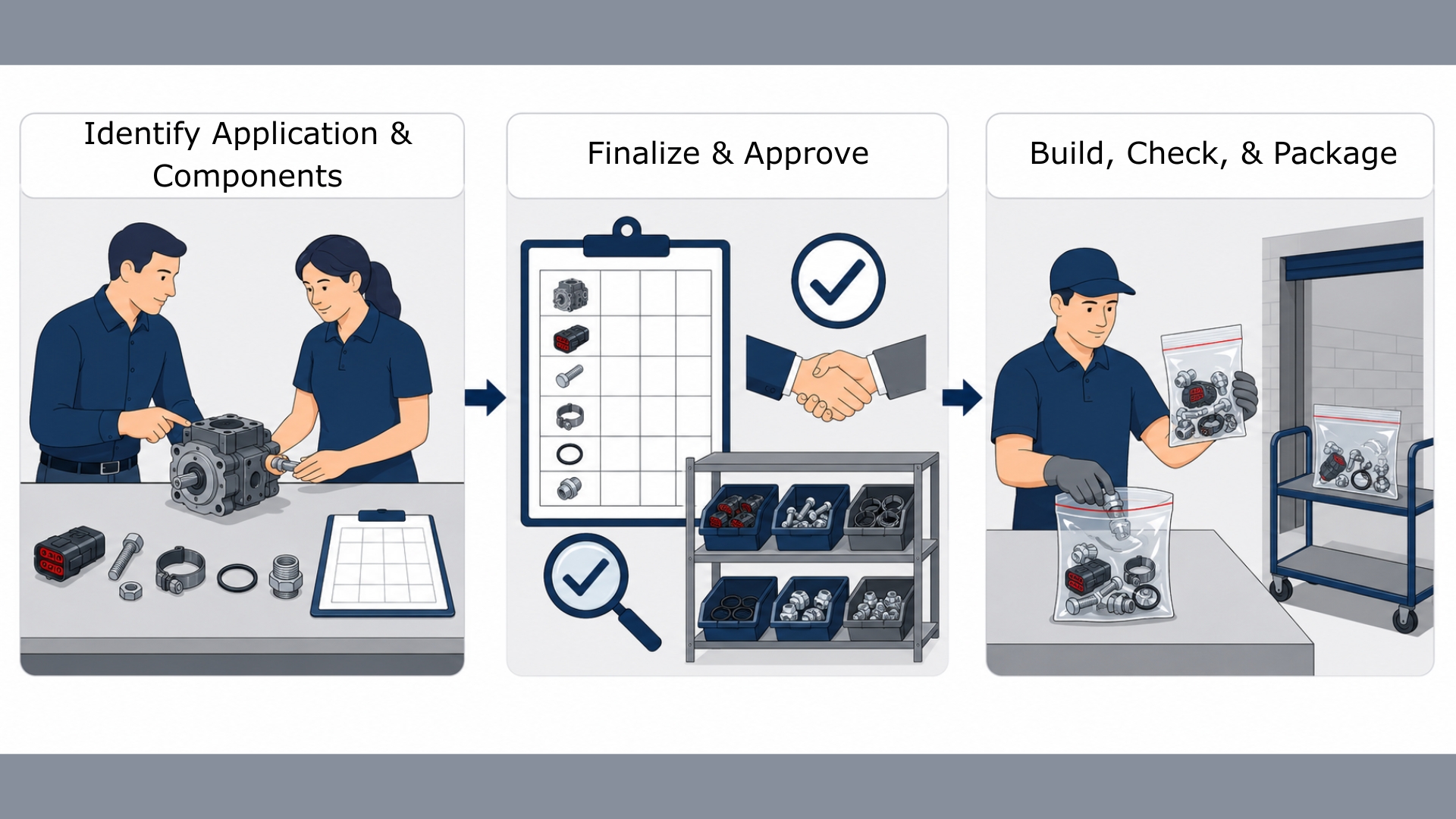
Ram Products uses a collaborative process to move from an identified application to an assembled kit. Based on Ram's confirmed process, the work follows three main stages.
1. Identify the Application and Required Products
The process begins by examining a task or production process that may benefit from custom kitting. The customer and a Ram product expert identify the products required for the proposed kit.
This discussion should begin with the work itself:
- What application is the kit intended to support?
- Which components must be available before that work begins?
- Where does the current preparation process create avoidable searching, handling, or coordination?
Starting with those questions keeps the proposed kit connected to a defined operational need.
2. Finalize and Approve the Kit Contents
Once the required products have been identified, the BOM is finalized. The customer approves the final kit contents, while Ram verifies product availability. Ram has thousands of products in stock and access to thousands more, allowing its sourcing team to help locate certain products that are not currently stocked. (Ram Products, Custom Kitting Services)
The result is an agreed-upon kit specification that Ram's Operations team can follow. Ram can also revise an existing kit when the customer's requirements change.
3. Build, Check, and Package the Kit
Ram's Operations team receives the settled BOM and builds the kit to the agreed-upon specifications. The completed kit goes through a quality check before delivery.
Most Ram custom kits are packaged in sealed clear bags. When the included products are too large for a bag, a box may be used instead. The packaging format therefore depends on the products in the kit.
Kits are typically delivered to a customer's inbound receiving area, such as a parts room. In some situations, a Ram sales representative may hand off kits closer to the production line. Delivery location, timing, and lead-time expectations should be discussed for the specific program rather than assumed to apply to every customer.
What to Prepare Before Discussing a Custom Kit
A productive kitting discussion starts with clear information. Before contacting a supplier, prepare:
- The intended application: Identify the job, assembly, or process the kit will support.
- The current preparation problem: Describe where searching, gathering, availability, organization, or product visibility creates difficulty.
- The BOM: List the required products, quantities, and relevant specifications.
- Expected usage: Explain how often the kit will be needed and whether demand is consistent or variable.
- Approval responsibility: Identify who will review and approve the final kit contents.
- Receiving needs: Determine where the kits should enter the facility and who will manage them after receipt.
- Known changes: Flag upcoming BOM or process revisions before the kit is finalized.
- Timing requirements: Discuss scheduling needs directly; Ram provides lead-time information upon request.
This information helps a supplier understand both the contents of the proposed kit and the operational problem it should address. It also gives your team a clearer basis for comparing the future kitted process with the current one.
Explore Ram Products Custom Kitting Services
Custom kitting can be a practical way to organize required components before work begins, reduce parts gathering at the point of use, and improve visibility into the products assigned to a specific application. A sound evaluation starts with a defined process, an approved BOM, and a clear understanding of what the kit is expected to improve.
Ram Products works with customers to identify potential kitting applications, helps identify and source required products, assembles kits to the agreed-upon BOM, and performs a quality check before delivery. Because kitting is not the right material-supply method for every process, the first step is evaluating the application and current preparation workflow.